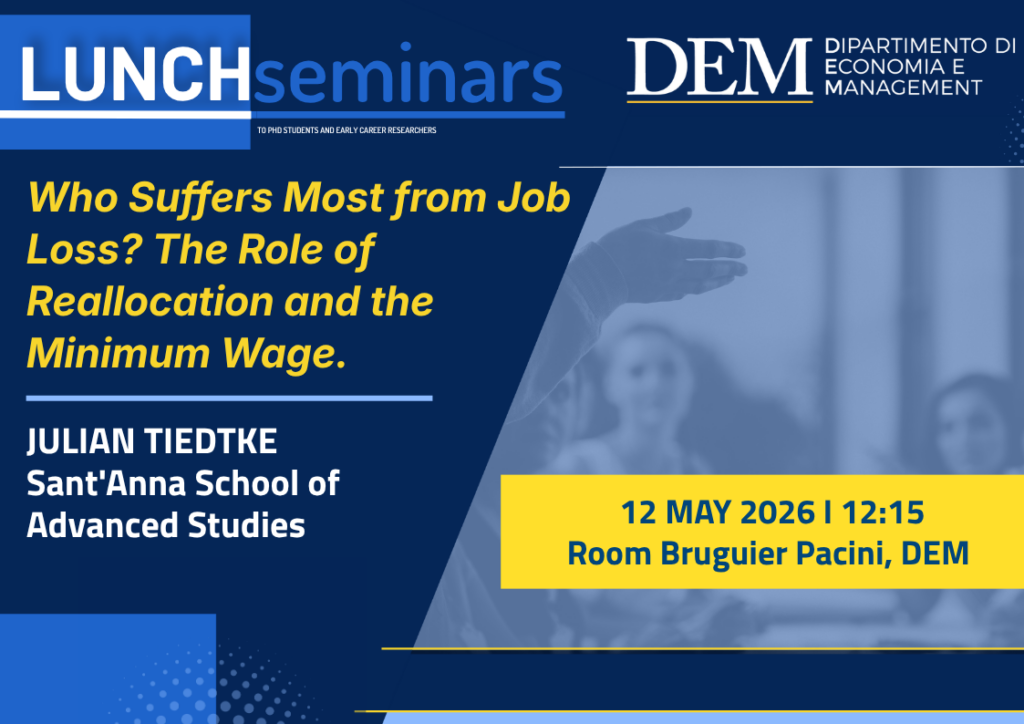
Date: Tuesday, 12 May 2026, at 12:15 pm
Venue: Seminar Room Bruguier Pacini, DEM
Speaker: Julian Tiedtke, Sant’Anna School of Advanced Studies
Abstract: This paper studies heterogeneous effects of job loss across the wage distribution in Portugal using linked employer–employee data from 2004–2021. We combine a matched difference-in-differences event-study design with the wage determination framework of Bonhomme et al. (2019). Methodologically, we extend the estimator of Callaway and Sant’Anna (2021) to incorporate cohort-specific matched control groups and address cross-cohort heterogeneity, an issue that has received limited attention in the prior literature. We find substantial heterogeneity across workers over time. Low-wage workers experience the largest earnings losses immediately after displacement, primarily driven by employment losses. However, they recover relatively quickly, such that five years after displacement the largest earnings losses are observed among higher-wage workers. This medium-run heterogeneity is mainly driven by hourly wages rather than employment. We further show that the minimum wage acts as an effective wage floor, preventing wage scarring among the lowest-paid workers without adverse employment effects. On the firm side, displaced workers reallocate toward more productive firms that share a smaller fraction of rents with workers, while firm wage premia explain little of the heterogeneity in earnings losses.