
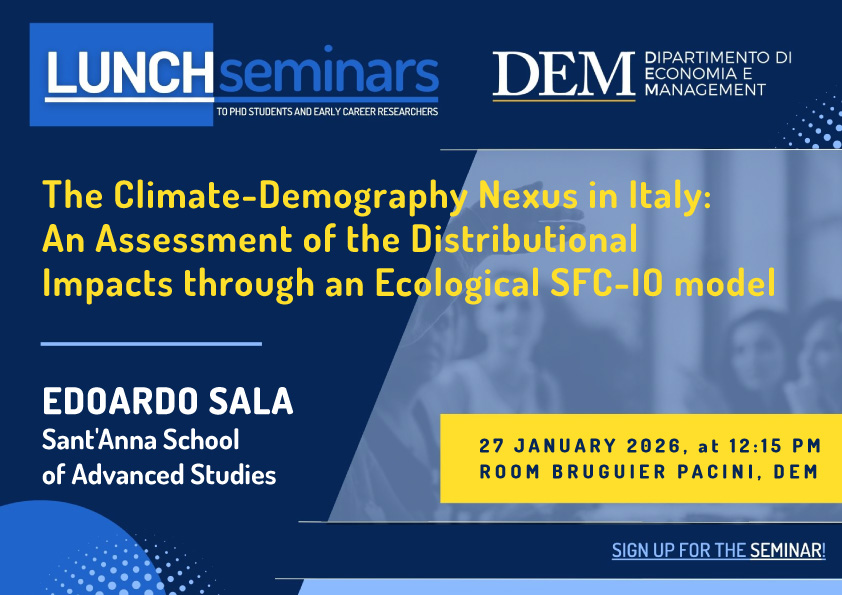
Date: Tuesday, 27 January 2026, at 12:15 pm
Venue: Room Bruguier Pacini, DEM
Speaker: Edoardo Sala, Sant’Anna School of Advanced Studies
Title: The Climate-Demography Nexus in Italy: An Assessment of the Distributional Impacts through an Ecological SFC-IO model
Abstract: This paper investigates how climate change affects income distribution through demographic channels, focusing on Italy as a case study. It develops a novel Ecological Stock-Flow Consistent–Input Output model TITANIC (Temperatures Impact and Transitions Analysis: Navigating Inequalities and Climate), which includes a social classes disaggregation of the household sector, and incorporates linkages between climate dynamics, mortality, and migration. Climate-induced increases in mortality and immigration are modeled to assess their macroeconomic and distributive consequences across three social classes—Capitalists, Managers, and Workers. Simulation results reveal that these demographic shocks generate heterogeneous impacts: rising mortality disproportionately reduces aggregate income and harms Capitalists’, while climate-driven immigration increases aggregate output but depresses Workers’ incomes, thereby amplifying inequality. When both channels interact, their effects are non-additive, with Managers emerging as the most resilient group. The study identifies four main transmission mechanisms—labor market dynamics, wages, profits, and age-group composition—through which climate-demographic interactions shape economic outcomes. The findings highlight the importance of integrating demographic-distributive feedbacks into climate–macroeconomic models and emphasize the need for climate policies that account for class-specific vulnerabilities.