
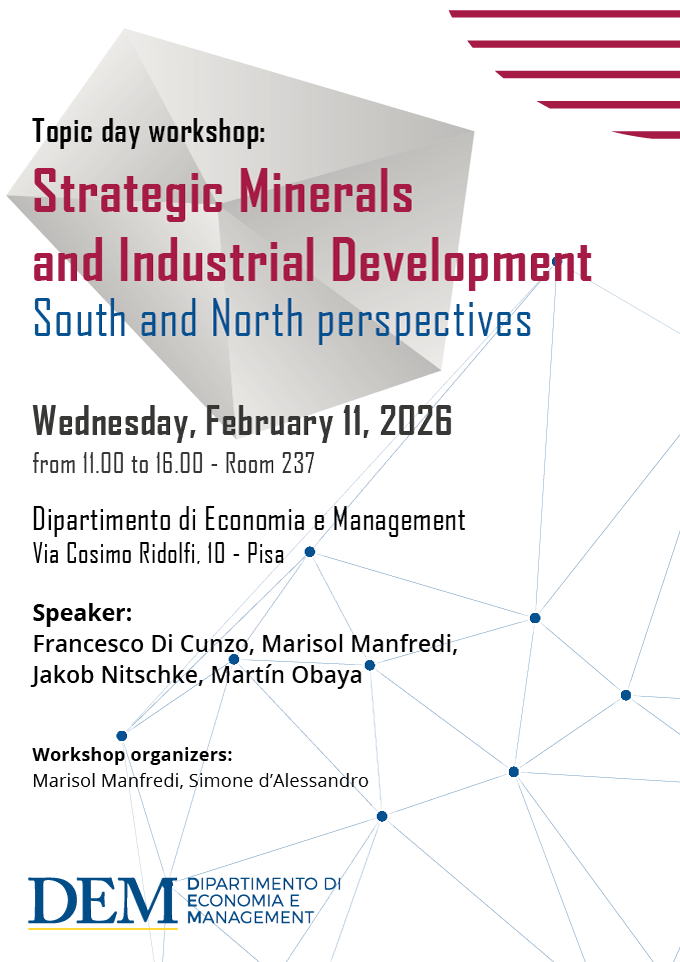
 Il Dipartimento di Economia e Management ospita il Topic Day Workshop “Strategic Minerals and Industrial Development – South and North perspectives”, una giornata di studio dedicata al ruolo delle materie prime critiche nella transizione energetica e nei processi di sviluppo industriale.
La giornata sarà articolata attorno al seminario di Martín Obaya (CONICET; CENIT-EEyN-UNSAM), che offrirà un’analisi comparata delle strategie di sviluppo basate sulle risorse naturali nel contesto della transizione energetica globale, con particolare attenzione al caso del litio nel Lithium Triangle (Bolivia, Cile e Argentina).
Accanto al seminario centrale, il workshop prevede interventi di Francesco Ghezzi, Marisol Manfredi e Jakob Nitschke, che presenteranno ricerche su temi quali i rischi di approvvigionamento delle materie prime critiche, le strategie di innovazione tecnologica e i costi socio-ecologici della transizione verde.
La giornata si concluderà con una tavola rotonda aperta alla discussione, favorendo il confronto tra prospettive del Sud e del Nord globale.
Luogo: Aula 237, Dipartimento di Economia e Management – Via Cosimo Ridolfi, 10, Pisa
Programma:
11:00 – Francesco Ghezzi, The renewable energy transition in Sub-Saharan Africa: artisanal mining, institutions and women entrepreneurship (30 min)
11:30 – Marisol Manfredi & Jakob Nitschke, The socioecological costs of the green transition. The case of lithium in Salinas Grandes, Jujuy, Argentina (30 min)
12:00 – Pausa (15 min)
12:15 – Seminario di Martín Obaya, Global dynamics and national legacies in resource-based development. The case of the Lithium Triangle(1h15 min)
13:30 – Pranzo
14:30 – Tavola rotonda – Open discussion
16:00 – chiusura
Martín Obaya (CONICET; CENIT-EEyN-UNSAM)
Date of the seminar: 11/2/2026 – 12:15h aula 237 (“Topic day” from 11am, same room)
Title of the seminar: “Global dynamics and national legacies in resource-based development. The case of the Lithium Triangle”
Abstract:
Minerals are central to the global energy transition, and resource-rich countries increasingly view this context as a window of opportunity for development. Yet, despite broadly shared objectives, they have adopted markedly different strategies in terms of their goals, scope, policy instruments, and the balance of authority between state and market actors. Focusing on the case of lithium in Bolivia, Chile, and Argentina, this article firstly develops a typology of development strategies: Neoliberal, State-led, and Hybrid. Secondly, it traces the evolution of these strategies and explains their divergence through the interplay between external forces –such as international development paradigms and technological or market dynamics– and domestic historical legacies. While external factors may favour certain strategic orientations, domestic institutional legacies have been decisive in defining the scope and direction of state action. The presentation aims at providing new insights into how resource-rich countries manage the challenges and opportunities of the energy transition by navigating the complex interaction between international pressures and domestic constraints to reposition themselves within global supply chains.